What 20 Years as a Rad Tech Taught Me About This Profession
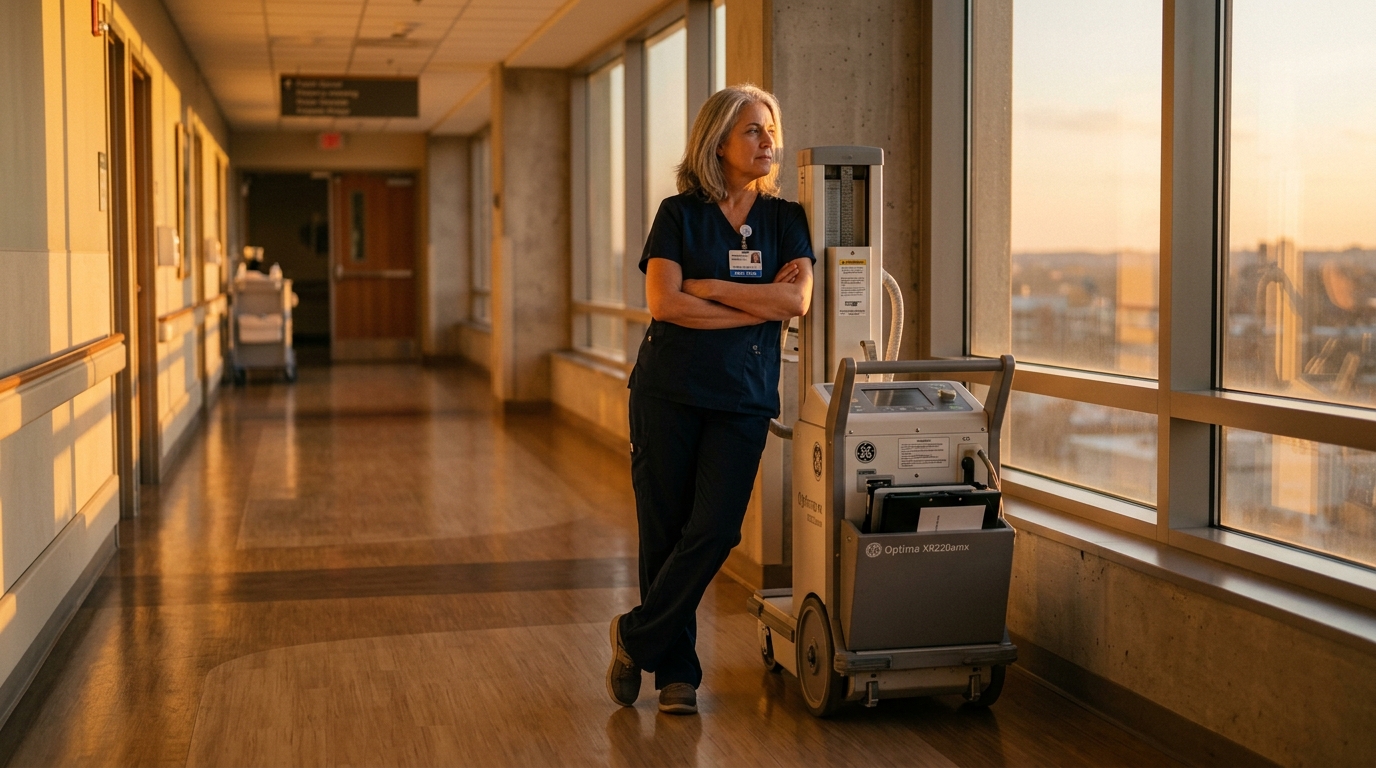
The Thing They Don't Tell You in School
When I started my radiologic technology program in 2004, I was twenty-two years old and thought I understood what I was signing up for. I liked science. I was good with equipment. I wanted to help people. Seemed straightforward.
Twenty years later, I realize how little I actually understood about what this profession would ask of me, teach me, and ultimately give back to me.
I'm sitting in my office right now—I manage the imaging department at our hospital now, but I still work clinically three days a week because I'd go crazy if I didn't—thinking about what to write for this. There's a lot I could talk about. Technical changes I've witnessed. Certification milestones. Career progression. But those feel surface-level compared to what I actually want to say.
So let me start here: the thing they don't tell you in school is that this profession will ask you to care about people you'll never know, on the worst days of their lives, and that this burden and privilege will reshape you.
It took me about five years to really understand what that meant.
The Patient You Never Forget
I remember a woman who came in for a chest X-ray. She was maybe fifty, clearly anxious, came in without anyone to support her. I took her to the imaging room, and she started crying about her recent diagnosis. She wasn't asking for medical advice—she was just scared, and she needed someone to acknowledge the fear.
I'm not a counselor. I didn't say anything profound. I just stopped for a moment, looked at her, and said something like, "This is scary. And we're going to get the images the doctor needs to help you."
She calmed down. I took the X-rays. She left. I never saw her again.
But I thought about her for years. Still do, honestly. I've never known what happened to her. She recovered or she didn't. She's doing well or she's not. I'll never know.
What I learned from that brief encounter—which is repeated thousands of times across every imaging department in the country—is that the work matters on a level that's not quantifiable. You're not the doctor. You're not diagnosing. You're not curing. But you're part of the moment when someone is confronted with their own mortality, and you have the ability to make that moment slightly more human.
That matters. And if you let it, it will change how you do this work.
On Technical Excellence and Why It Matters, But Not In The Way You Think
I'm a competent tech. I know my equipment. I understand protocols. I can solve problems on the scanner. Over twenty years, I've gotten good at this technical side of the work.
And I'll tell you the honest truth: the technical excellence matters, but not because it makes you feel accomplished. It matters because it's the only ethical way to treat a patient.
When you take an imaging exam, you're asking someone to be still, sometimes while in pain. You're asking them to hold their breath. You're exposing them to radiation. They're doing this because they're sick or injured or scared, and they're trusting that the image you produce is going to be good enough to help their doctor help them.
If you're careless with that responsibility—if you take mediocre images because you're rushing, if you don't bother to get the angle right, if you repeat studies because you weren't paying attention—you're not just doing bad work. You're violating a trust.
I've seen new techs—bright, eager, technically competent—who hadn't yet connected with why the technical excellence mattered. It was just a job to them. And the difference in how they worked, in the energy they brought, in the results they produced, was visible.
The ones who understood that technical excellence was an expression of respect for the patient? They became the ones people wanted in the room during difficult cases.
That's not a small thing.
The Industry Changed, And I Had To Change With It
I started in 2004 with film-based radiography. We had just gotten our first PACS system. Digital radiography was coming. CT was growing. MRI was becoming more sophisticated. Ultrasound was still mostly done by radiologists.
I've watched technology transform this profession more in twenty years than probably happened in the previous fifty. Digital everything. AI integration. Mobile imaging. Point-of-care ultrasound. Real-time guidance for procedures. The complexity has exploded.
I could have decided that the profession I learned was good enough and resisted the changes. I knew techs who did. Some of them eventually moved into administrative roles where they could avoid learning new systems. Others retired earlier than they might have. A few just burned out and left the profession entirely.
I decided—consciously, multiple times—to lean into the changes. I got certified in CT. Then MRI. I learned the new PACS systems. I took courses on emerging technologies. I didn't do this because I'm inherently fascinated by equipment. I did it because the patients I was serving deserved to be imaged with the best technology available, and that meant I had to keep learning.
The most important lesson from this stretch of time is this: your willingness to change is not a sign of weakness or uncertainty. It's a sign of commitment to your profession and your patients.
The techs I know who are most satisfied with their careers twenty years in are the ones who viewed learning as permanent. Not something you do in school and then stop. Something you do continuously because the work demands it.
The Relationships That Made Everything Matter
You spend more time with your work colleagues than you do with your family. I mean, if you add it up—forty hours a week, five days a week, forty-eight weeks a year, it's more of your conscious life than you actually spend with spouses or kids.
That proximity either builds something real or it builds frustration, depending on how you approach it.
I've been fortunate to work with some genuinely good people. The radiologist who trusted my clinical judgment enough to bounce questions off me. The nurses who treated imaging techs like colleagues, not assistants. The other techs who mentored me early on and modeled professionalism and kindness.
Those relationships mattered more to my career satisfaction than I can adequately express. And I've also worked alongside people who were brilliant technically but difficult personally, and I've discovered something interesting: the brilliant but difficult ones tend to be less happy long-term.
This is important enough that I'll say it clearly: how you treat people at work is not separate from your career satisfaction. It's central to it.
I've made it a point for the last several years to intentionally build relationships with younger techs. Not just training them on protocols, but actually knowing them. Knowing their names, their goals, what they're struggling with, what excites them. The investment in those relationships has probably been the most meaningful part of my later career.
A tech I mentored ten years ago came back recently and told me that our conversations early in her career shaped her decision to stay in radiology instead of leaving. That matters to me more than any certificate or promotion ever has.
On Avoiding Burnout (And What It Looks Like When You Don't)
Here's the thing about healthcare work, especially in imaging: there's always more to do. The schedule is always full. Staffing is always tight. Imaging demand never stops. The potential to work yourself into the ground is infinite.
I've seen colleagues do it. Great techs, genuinely committed to their work, who burned out hard. One of my friends stopped imaging altogether after fifteen years because he hit a wall where he couldn't stand being in an imaging department anymore.
I've thought a lot about why some people burn out and some don't. It's not who cares more. My friend who left? He cared deeply. It's something else.
I think it's about boundaries. It's about understanding—really understanding—that you are one person and you have finite energy. It's about saying no to things that don't fit your life. It's about going home and not checking email. It's about taking your vacation days. It's about having a life outside of work.
I'm not saying imaging doesn't matter. It matters profoundly. But it doesn't matter more than your health, your relationships, your peace of mind.
Early in my career, I thought demonstrating commitment meant being available all the time, staying late to help, picking up extra shifts, being always on. I was rewarded for that, so I kept doing it.
By year ten, I was genuinely exhausted. I loved the work but I hated the pace. I was cranky at home. I was making mistakes at work because I was tired. I was bitter about staffing because I was doing more than I should have been.
It took a serious conversation with my spouse and a health scare to make me change my approach. I set boundaries. I stopped picking up every extra shift. I left things incomplete at the end of my shift and didn't feel guilty about it. I took real vacations where I didn't work.
And you know what? The department didn't fall apart. The work got done. And I was happier, which made me better at the work I did do.
If you're early in your career and reading this, let me save you ten years of learning this the hard way: Take care of yourself first. You cannot pour from an empty cup, and imaging needs you here for the long haul.
On Purpose and Why This Work Matters
I'm not going to pretend that imaging is the most important work happening in healthcare. Surgeons save lives. Emergency physicians make split-second decisions that keep people alive. Nurses provide direct patient care in ways that are irreplaceable.
But I've come to understand that imaging is the detective work. It's the evidence gathering. It's the diagnostic foundation that everything else builds on.
A surgeon can't operate well if the imaging didn't reveal the problem. An oncologist can't treat a cancer if it wasn't identified on a scan. An interventional radiologist can't guide a needle if there's no image to guide by. A clinician in the ED can't rule out a pulmonary embolism without a PE protocol CT.
Imaging is the language that modern medicine speaks.
And that matters. Every time I take an image—whether it's a simple chest X-ray or a complex MRI with multiple sequences—I'm contributing to someone's diagnosis and treatment. I'm part of their journey toward recovery.
That's not nothing.
The Advice I'd Give To Myself At Twenty-Two
If I could sit down with the version of me who was starting radiologic technology school twenty years ago, what would I tell him?
Learn the technical skills well. Not just adequately—well. This is your foundation. It matters.
Understand that patients are people on their worst days. Treat them with genuine kindness, not just professional courtesy. The difference matters.
Build relationships with your colleagues. These are the people you'll spend years working alongside. Make it count.
Stay curious about how things work. The field is going to change, and you'll either change with it or become obsolete. Choose to change.
Don't sacrifice your health for the job. No amount of career achievement is worth burning out.
Remember why you came into this profession. Check in with that motivation regularly. If it's still there, nurture it. If it's gone, figure out what that means.
Be generous with knowledge and mentoring. The profession gave you a path and training. Pass that on.
Understand that success looks different at different life stages. What success looks like at thirty isn't what it looks like at fifty. That's okay.
Find meaning in the work itself, not just in advancement. The imaging itself can be meaningful. Let it be.
A Profession Worth Building A Life In
I'm not going to retire for a few more years, and I haven't entirely decided what that will look like. Maybe I step back to mentoring and education only. Maybe I keep working clinically part-time. Maybe I do something entirely different.
What I know is that this profession—radiologic technology—has given me a meaningful career. Not because it's glamorous or especially lucrative, but because it's allowed me to do work that matters, alongside people I respect, in a role that lets me help when people are scared and need help.
That's actually quite a lot.
If you're thinking about entering radiologic technology, or if you're early in your career and wondering if you made the right choice, or if you're mid-career and questioning where you're going, or if you're toward the end of your career wondering if it all meant something: I can tell you from the vantage point of twenty years that it's worth building your life in.
Not because it's easy—it's not. Not because it's always rewarding—it's not, at least not in obvious ways. But because there's something genuinely good about being part of the diagnostic process, about being trusted by patients, about being part of the team that helps people get the imaging they need.
Welcome to radiology technology. I hope you'll stay awhile.
This marks the 100th post in RT Job Bank's professional development series. From contrast certification to career philosophy, from hiring strategies to educational challenges to personal reflection, these posts have explored what it means to build a career in radiologic technology. Thank you to every technologist who has shared their wisdom, experience, and insight in these pages. The profession is built by people like you.
Related Articles

Burned Out as a Rad Tech? Here's How to Reignite Your Career
April 23, 2026

Managing Up: How Rad Techs Can Influence Department Decisions
April 22, 2026

How to Compete With Travel Agency Pay Without Breaking Your Budget
April 22, 2026
Quality Assurance in Radiology: Why QA Culture Affects Retention
April 21, 2026